

Do You Need New Dating Profile Photos? How to Tell What Your Profile Actually Needs
Do you need new dating profile photos? Maybe—but the answer isn’t automatically yes. New photography can be extremely useful when your current images are outdated, incomplete, repetitive, or simply don’t represent the person you are today.
But sometimes the photographs themselves aren’t actually the problem.
You may already have several strong images and be dealing instead with photo order, repetition, a weak opening image, mixed signals between your photos and prompts—or a profile that simply isn’t working particularly well as a whole.
That’s an important distinction.
Not every dating-profile problem is a photography problem.
And before you throw out every photograph you’ve got and start over, it helps to figure out what actually needs changing.

Start With a Better Question Than “Are These Good Photos?”
When people ask me to look at their dating photos, they often approach them one at a time.
- Is this one flattering?
- Do I look good here?
- Which one do you like better?
- Should I use this picture?
Those are reasonable questions.
They’re just not the only questions that matter.
You can have six individually good photographs and still have a profile that feels confusing, repetitive, overly professional, outdated, or oddly impersonal.
That’s because people don’t experience your dating profile one photograph at a time.
They experience the pattern.
So instead of asking only: “Are these good pictures of me?”
I would also ask: “What does someone understand about me after seeing all of them together?”
That distinction is where photo strategy begins.
7 Signs You Probably Need New Dating Profile Photos
There isn’t a magical expiration date stamped on every dating photograph.
But there are situations where I’d be much more likely to recommend new photography.
1. New Dating Profile Photos May Help When You No Longer Look Like Your Current Images
- This is the clearest one.
- Maybe your hair has changed.
- You wear glasses now.
- Your personal style is different.
- You’ve grown a beard, lost one, changed your hair color, or simply look different because several years have passed.
You don’t need to replace a photograph because you aged twelve months.
You should replace it when someone meeting you now would reasonably feel that the photograph represented an earlier version of you.
That doesn’t mean choosing less flattering photographs in the name of honesty.
It means choosing flattering photographs of the person someone would actually meet.
That matters especially for adults returning to dating after several years away.
It can be tempting to reach back into the camera roll for the period when you happened to have more photographs of yourself.
But your dating profile isn’t an archive.
It represents who you’re introducing now.
2. You don’t have one strong, current solo photo of your face
Your opening image shouldn’t make someone solve a puzzle.
If your best current options are:
- sunglasses
- group photos
- distant vacation pictures
- heavily cropped images
- car selfies
- old professional photographs
- or something where another person’s shoulder is still mysteriously attached to you
then photography may genuinely be a missing piece.
Your first image doesn’t need to be a formal headshot.
It does need to make it easy to recognize you.
Clear face. Current appearance. No guessing.
Simple is often surprisingly powerful.
3. You May Need New Dating Profile Photos If Your Current Set Was Built by Accident
This is incredibly common.
Most adults aren’t walking through everyday life thinking:
This brunch really needs a strategically useful three-quarter-length photograph of me.
So when it’s time to build a dating profile, people use whatever survived the camera roll.
- A friend’s wedding.
- A work event.
- A vacation from four years ago.
- A family photograph with several people cropped out.
- One decent selfie.
- A group picture.
- Another group picture.
- Possibly a dog who is considerably better photographed than the human who owns him.
None of those images is automatically bad.
The issue is that they were never created with the collection in mind.
If you’re constantly trying to make unrelated photographs behave like a cohesive set, new photography may give you the missing visual foundation.


4. All of your good photos are professional photos
This happens constantly with established professionals.
You may already have beautiful images for LinkedIn, your company bio, speaking events, publications, or your business.
But professional headshots and dating photographs aren’t necessarily doing the same job.
Your dating profile needs more than evidence that you’re employable.
It needs enough information to show something about your life outside work.
If every strong photograph you own involves a blazer, a neutral background, and the facial expression you use when someone says, “Now give me approachable executive,” you may not need better-quality photos.
You may need different kinds of photos.
This is exactly what I unpack in my article about professional headshots vs. dating profile photos.
5. Every photo is basically doing the same job
This one can be harder to spot because you may genuinely like every image.
Imagine:
- A close portrait.
- Another close portrait.
- A seated portrait.
- A slightly wider portrait.
- A different shirt.
- Another smile.
Technically, they’re different photographs.
Strategically, they’re almost identical.
Strong dating-photo sets usually benefit from variation in:
- framing
- expression
- wardrobe
- environment
- physical context
- lifestyle information
- energy
Not because every image needs to be wildly different.
It doesn’t.
The goal is range without randomness.
If your current photographs can’t provide that range, creating a new set may make sense.
6. Your photos represent a life you aren’t really living anymore
This is different from simply looking older.
- Life changes.
- Divorce.
- Widowhood.
- Career changes.
- Relocation.
- Children growing up.
- A major change in how you spend your time.
- A new city.
- A new chapter.
Sometimes the photographs technically still look like you, but the life surrounding you in them is no longer yours.
That matters.
A dating profile doesn’t need to document every meaningful part of your life.
But the environments, clothing, activities, and visual cues in your photographs collectively tell a story.
If you’re still using images from a version of life you’ve moved beyond, new photography can help bring the profile into the present.
7. You’re keeping weak photos simply because you need to fill the slots
This is one of the easiest diagnostic clues.
If you look at one or two photographs and think:
“I don’t love this one, but I need another picture…”
you may have a photography shortage.
Not every image needs to be your favorite photograph you’ve ever seen of yourself.
But every photo should earn its place.
A weak sixth photograph doesn’t become strategically useful just because the app gave you another slot to fill.
If there simply aren’t enough current, useful photographs available, that’s a reasonable reason to create more.
5 Signs You May Not Need New Dating Profile Photos
Now for the part photographers don’t always lead with: you may not need new dating profile photos at all.
You may already have what you need.
And if that’s true, I’d rather you know that before investing in a full session.
1. You already have several current, clear photographs
If your images:
- look like you now
- clearly show your face
- include useful framing variety
- reflect your actual lifestyle
- and collectively provide more than one dimension of you
then replacing all of them may solve nothing.
The issue may be elsewhere.
2. Your strongest photograph is simply in the wrong position
Photo order matters.
The photograph someone eventually loves after scrolling through your profile may not be strong enough to get them interested in scrolling in the first place.
Likewise, your favorite photograph isn’t automatically your best opening image.
Sometimes nothing needs to be reshot.
The lineup simply needs to be reconsidered.
3. Two or three photos are repeating the same information
You might have plenty of strong images but too much duplication.
- Three similar selfies.
- Two nearly identical travel photographs.
- Multiple photos wearing sunglasses.
- Several polished portraits.
The fix may be removing or replacing one photograph rather than rebuilding the entire library.
A profile doesn’t become stronger simply because every available slot is occupied.
4. The photos are strong, but the profile feels disconnected
Your photographs don’t exist independently from your prompts, bio, captions, interests, and other information.
If the images suggest one personality while the written profile suggests something completely different, the problem may be the relationship between the pieces.
This is one of the reasons I think about dating profiles as systems.
Your profile may be saying something different than you think.
5. You genuinely can’t identify what’s wrong
This is where I would resist the urge to randomly change everything at once.
- New opener.
- New prompts.
- Swap three photos.
- Rewrite bio.
- Delete profile.
- Rebuild profile.
- Switch apps.
- Repeat Tuesday.
If you already have several strong current photographs, making more photographs before understanding the existing profile may simply give you more options to be uncertain about.
That’s when diagnosis can be more useful than another round of changes.
A 10-Minute Dating Photo Self-Audit
Before deciding whether you need a photographer, try this.
Open your dating profile and look only at your photo lineup.
Ignore your written prompts for a few minutes.
Now ask yourself five questions.
1. Would a stranger clearly understand what I look like today?
Not what you looked like three summers ago.
Not what you look like from one flattering angle.
You now.
2. Does every photograph add something different?
You don’t need six personalities.
But each image should contribute some new information.
- Different expression.
- Different environment.
- Different framing.
- Different side of your life.
Something.
3. Can someone see more than my face?
Your profile should usually provide enough visual context to understand your physical presence, not just a sequence of shoulder-up portraits.
That doesn’t mean you need a stiff “full body picture.”
It means the overall set shouldn’t leave major visual questions unanswered.
4. Do these photographs resemble my actual life?
Look at:
- wardrobe
- settings
- activities
- level of formality
- social context
Would someone meeting you recognize the same person these photographs suggest?
If you’ve created an imaginary lifestyle because you thought it would photograph well, you’ve solved the wrong problem.
5. What does the weakest photograph contribute?
This is my favorite question.
Not: “Is it terrible?”
Ask: “If I removed this photograph, would the profile lose anything important?”
If the answer is no, it may not belong there.
That is a much better test than whether the photograph is objectively attractive.
Good Photos and the Right Photos Are Not Always the Same Thing
This is where people get tripped up.
A photograph can be:
- beautifully lit
- technically excellent
- flattering
- professionally taken
and still not contribute much to your dating profile.
The opposite can also happen.
A simple photograph taken by a friend may be incredibly useful because it shows an expression, environment, activity, or side of you that the rest of the profile is missing.
I am a professional photographer.
I am not going to sit here and tell you that every dating photograph must have been taken by a professional photographer.
It doesn’t.
What matters is whether the images work together.
Professional quality is useful. Professional-looking is not the goal.
The goal is a clear, believable, current visual representation.


When New Dating Profile Photos Are Worth Considering
There are situations where new dating profile photos solve a very real problem.
You simply don’t have enough current photographs
This is especially common among adults who:
- aren’t active on social media
- are usually the person taking the pictures
- recently became single
- have mostly family photographs
- have mostly professional imagery
- dislike having their picture taken
You aren’t failing at dating because your camera roll is terrible.
You may simply not have had a reason to build a current photo library.
You hate being photographed
This is one of the most common things clients tell me.
- They don’t know where to put their hands.
- They don’t know how to stand.
- They freeze when a camera appears.
- They feel like every smile looks forced.
That doesn’t mean you’re “unphotogenic.”
It usually means you need good direction.
My role isn’t to expect you to arrive knowing how to pose.
It’s to create enough structure, movement, conversation, and guidance that you can stop thinking quite so hard about the camera.
You’re entering dating after a major life transition
If you’ve been married for fifteen or twenty years, there’s a decent chance your recent photo library wasn’t built with dating in mind.
And why would it have been?
The goal isn’t to manufacture a shiny new single-person identity.
It’s to create images that reflect who you are in this chapter, rather than relying entirely on photographs from the last one.
You want a complete set instead of one good picture
Sometimes the problem isn’t getting a good photograph.
You already know you can do that.
The challenge is creating a set with enough intentional variety to support an entire profile.
That’s where planning wardrobe, locations, image roles, expressions, and environments together becomes genuinely useful.

When a Profile Audit Is the Smarter First Step
Photography and profile strategy solve different problems.
I’d lean toward an audit first when:
- you already have several current photographs you like
- you can’t tell whether the opener is the problem
- you’re unsure which images to remove
- you have multiple good options and no idea how to order them
- your photographs seem fine but the profile still feels “off”
- you suspect your prompts and photos may be sending mixed signals
- you don’t want to invest in photography unless it’s actually necessary
My Match-Ready™ Profile Audit looks at your existing photos, photo order, prompts, bio, overall flow, and first impression together.
And yes—sometimes the recommendation is that stronger photography would help.
Other times it isn’t.
If your current images can work better through stronger selection, sequence, or profile strategy, I’d rather tell you that.
What New Dating Profile Photos Should Actually Solve
If you decide you do need new photography, the goal shouldn’t be: “I need prettier pictures.”
That’s too small.
The better question is: “What information is my current profile missing?”
Maybe you need:
- a clearer opening portrait
- a natural full-body image
- more warmth in your expression
- less professional formality
- more lifestyle context
- a different wardrobe
- a relaxed everyday image
- something that shows another side of your personality
- or simply photographs that look like you today
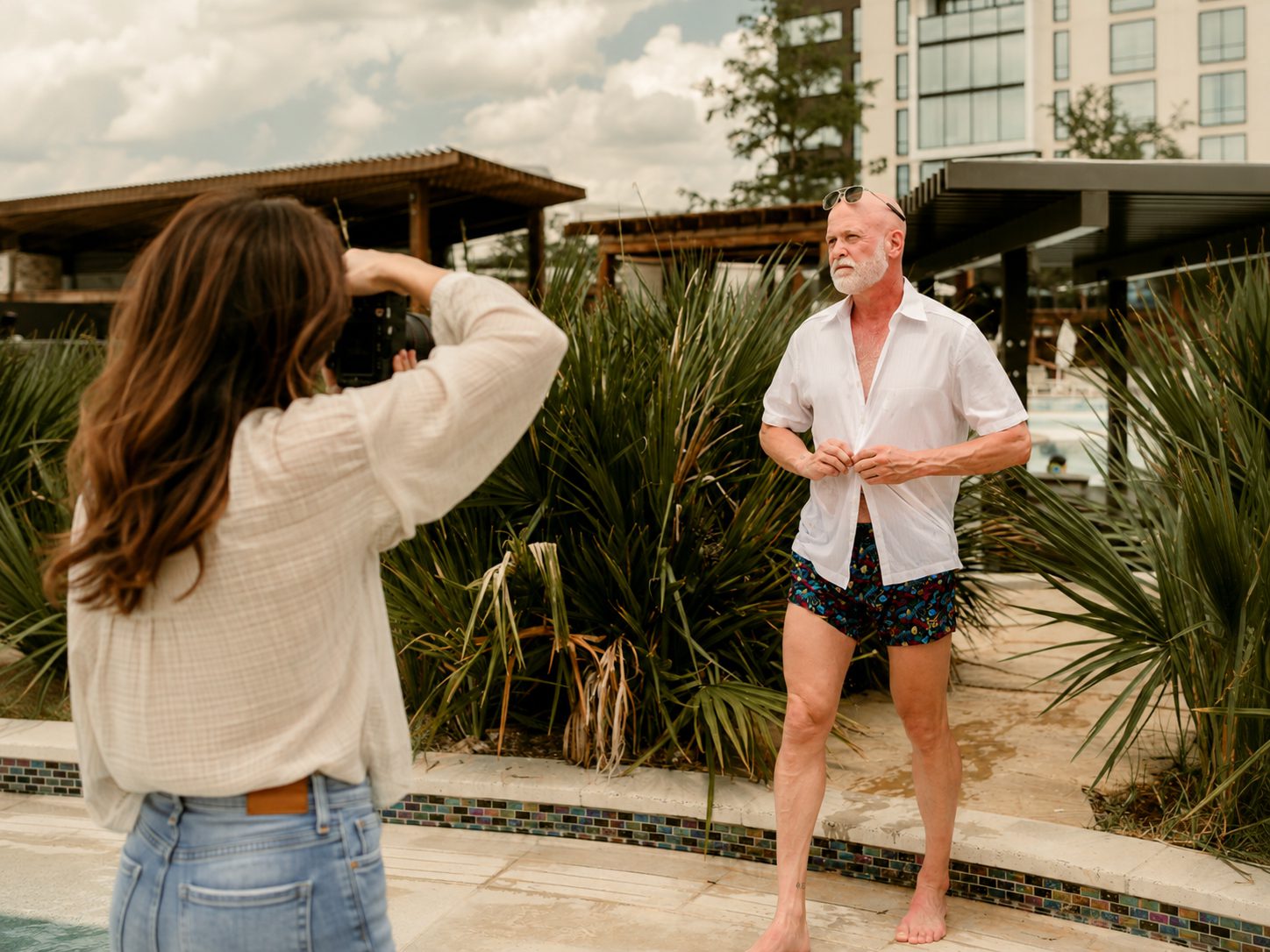
That’s how I approach dating photography.
The session isn’t a random collection of locations and outfits.
Before we photograph anything, I’m thinking about what the final set needs to accomplish.
- What roles are already covered?
- What’s missing?
- What should the photographs communicate?
- Where do we need range?
- And what would feel completely unlike you, even if it photographs beautifully?
That’s the difference between creating portraits and creating photographs intended to function together on a dating profile.
What About Phone Photos, Selfies, and Photos Taken by Friends?
Use them if they’re good.
Really.
A strong dating profile does not require six professionally photographed images.
- A current phone photograph can absolutely belong.
- A spontaneous photograph taken by a friend can absolutely belong.
- A travel image can belong.
- A social photograph can belong.
- Even a selfie may have a place depending on the rest of the set.
The issue isn’t whether a photograph carries the invisible stamp of Professional Photographer Approval™.
The issue is:
What is it contributing?
If it provides useful information and works with the other photographs, it may deserve its spot.
If it exists only because you needed something for slot number five, that’s different.
What This Looks Like for Dallas–Fort Worth Clients
Since relocating to Dallas, one thing I pay particular attention to is creating photographs that actually make sense for the client’s life here.
Dallas gives us enormous variety.
- Polished urban environments.
- Neighborhood settings.
- Architecture.
- Green spaces.
- Patios.
- Residential-feeling spaces.
- Coffee shops.
- Restaurants.
- More relaxed outdoor locations.
But the goal is not to make your dating life look aggressively Dallas.
You do not need a skyline, cowboy boots, a margarita, and the Margaret Hunt Hill Bridge all fighting for space in the same profile to prove geographic residency.
Location should support you.
For one client, that might mean a more refined city environment.
For another, home, neighborhood, coffee, nature, or somewhere quiet.
The best location isn’t the most impressive one.
It’s the one that helps the photograph make sense.


If You Think You’re “Not Photogenic”
You do not need to become comfortable in front of a camera before hiring a photographer.
That would be a little like getting in shape before you’re allowed to go to the gym.
I’ve been photographing people for more than 16 years, and many of the adults who come to me begin by saying some version of: “I hate having my picture taken.”
That’s useful information.
It tells me how I need to work with you.
- Some people need movement.
- Some need conversation.
- Some need more direction.
- Some need less.
- Some need thirty minutes before they stop monitoring every inch of their face.
My job isn’t to turn you into someone who loves being photographed.
It’s to guide the process well enough that the discomfort isn’t the thing showing up in every frame.
So… Do You Actually Need New Dating Profile Photos?
Maybe.
And that’s a perfectly useful answer.
You probably do need new photographs if your current images:
- no longer look like you
- are mostly old or borrowed from another chapter of life
- don’t provide a clear solo opening image
- are almost entirely professional headshots
- repeat the same visual information
- lack useful lifestyle or physical context
- leave you filling profile slots with photographs you don’t actually want to use
You may not need a new session if:
- you already have several current, useful photographs
- the main problem is photo order
- you’ve included too many similar images
- one weak photograph is dragging down the set
- your prompts and photos aren’t supporting each other
- you simply can’t tell what the real problem is yet
The important part is not changing everything because you’re frustrated.
It’s figuring out what actually needs changing first.
Frequently Asked Questions About New Dating Profile Photos
1. How often should I update my dating profile photos?
There isn’t one universal timetable. Update photographs when they stop representing how you currently look or how you actually live. A photograph doesn’t become useless because it had a birthday. But if your appearance, lifestyle, location, or life circumstances have meaningfully changed, it’s worth reviewing whether the image still belongs.
2. Do all of my dating profile photos need to be professional?
No. A strong profile can absolutely combine professional photography with appropriate candid, social, travel, activity, or phone photographs. The set matters more than the provenance of every individual image.
3. Can good phone photos work on Hinge or Bumble?
Absolutely. If the photograph is clear, current, flattering, and contributes something useful to the profile, there is no reason to discard it simply because it wasn’t taken with professional equipment. Both Hinge and Bumble structure profiles around multiple images and encourage profiles that give people a broader sense of who you are; Bumble specifically recommends clear images showing different aspects of your life.
4. How many dating photos do I need?
That depends partly on the platform. Rather than obsessing over hitting a magical number, make sure you’re using the available photo space intentionally. Hinge currently requires multiple photos as part of a complete profile, while Bumble recommends several photos and specifically encourages variety. We’ll go much deeper into how many dating profile photos you need and what job each one should perform in another guide.
5. Should my first photo be professionally taken?
Not necessarily. Your first photograph should make you easy to identify and create an accurate first impression. If a professional photograph does that best, wonderful. If your strongest opener is an excellent current photograph someone else took, use it.
6. What if I’m not getting matches?
Don’t assume that automatically means the photographs are bad. Dating-app response can be affected by many factors outside my professional lane, and match count by itself isn’t enough to diagnose a photography problem. What I can evaluate is whether your visual profile is current, coherent, varied, and clearly representing you.
7. Should I book a photo session or a profile audit first?
If you clearly lack current, useful photographs, photography is probably the more direct path. If you already have a decent photo library and can’t tell what’s going wrong, start with the audit. That gives us something concrete to evaluate before you invest in changes you may not need.
You Don’t Need New Photos Just Because Dating Feels Frustrating
It is very easy to assume: My profile isn’t getting the response I expected, therefore I need entirely new photos.
Sometimes that’s correct.
Sometimes the photography really is the weak link.
But sometimes you already have useful raw material and simply need to understand how the pieces are working together.
My goal isn’t to convince everyone reading this article to book a photography session.
It’s to help you make the right next decision.
If your current photo library no longer represents who you are, explore my Dallas dating photography experience and Dating Photos That Work™ approach.
If you’re looking at your profile thinking, “I genuinely cannot tell what’s wrong,” start with the Match-Ready™ Profile Audit.
Because before you change everything, it’s worth understanding what actually needs changing.
If your current photo library clearly no longer represents you, start with photography. If you already have decent photos and aren’t sure what’s creating the disconnect, start with the profile you already have.
Build a current, intentional set of dating photos around who you are now and what your existing profile is missing.
Explore Dating Photography →Find out whether the issue is photography, selection, sequence, written content, or the overall pattern before changing everything at once.
Explore the Profile Audit →
Shannon O’Malley is the Dallas-based dating profile photographer + profile strategist behind Shannon Kathleen Photography and creator of Dating Photos That Work™.
She specializes in dating profile photography, visual first impressions, photo strategy, photo selection and order, and natural portraiture designed to feel current and genuinely representative of the person being photographed.
Shannon’s work has been featured by CBS/WCCO, CNN Newsource, Bella Grace Magazine, Rangefinder, and other media outlets.
She serves Dallas-Fort Worth year-round, with occasional Twin Cities dates and travel by request.
Leave a Reply
AS SEEN IN + FEATURED BY


Be the first to comment